Tuesday, May 5, 2015

NASA tests aircraft that hovers like a helicopter, and flies like a plane

NASA tests aircraft that hovers like a helicopter, and flies like a plane
Welcome to the future of aviation.
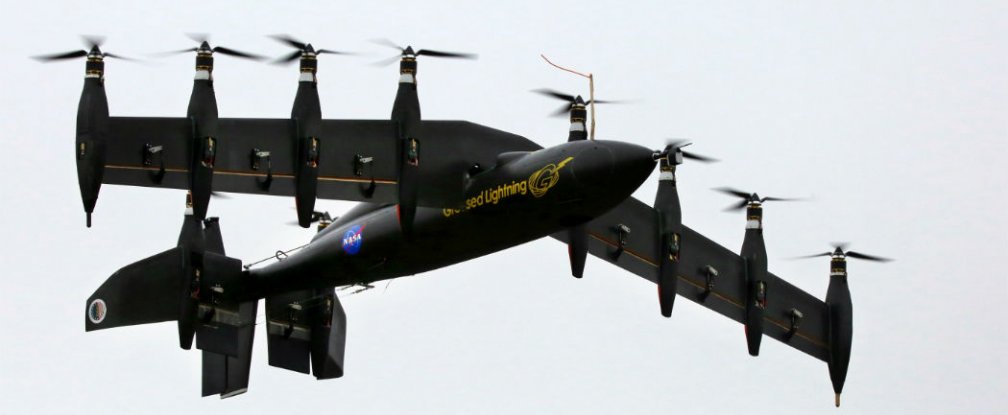
 
NASA engineers have successfully flown an unmanned aircraft that can takeoff, land and hover like a helicopter, and fly horizontally like a fixed-wing plane.


The team's battery-powered aircraft uses a system of 10 engines on tilted wings to achieve vertical takeoff and landing. During recent test flights near Langley Research Centre in the US, the prototype - known as Greased Lightning, or GL-10 - successfully transitioned to horizontal flight. You can watch the flight test in the above video.
"During the flight tests we successfully transitioned from hover to wing-borne flight like a conventional airplane then back to hover again. So far we have done this on five flights," NASA aerospace engineer Bill Fredericks said in a press release. "We were ecstatic. Now we're working on our second goal - to demonstrate that this concept is four times more aerodynamically efficient in cruise than a helicopter."
A hybrid aircraft that can fly vertically like a helicopter, but cover long distances at high speeds like a fixed-wing aeroplane, could offer enormous advantages for everything from military operations and search and rescue, to mapping.
One way of accomplishing this is by using rotors, or propellers, that tilt. For vertical flight, the rotor blades are angled along a horizontal plane, creating lift the way a helicopter rotor does. Then, as the aircraft gains speed, the rotors are progressively tilted forward, eventually reaching a vertical position where they generate propulsion. A good example of this is Boeing's V-22 Osprey.
But the NASA researchers were interested in developing a new system, which could be more aerodynamic.
The NASA researchers say they'd built 12 prototypes before this latest one, beginning with some good old foam models that were subjected to some pretty strong impacts. They eventually graduated to fibreglass hobby planes.
"Each prototype helped us answer technical questions while keeping costs down. We did lose some of the early prototypes to 'hard landings' as we learned how to configure the flight control system," said project engineer David North. "But we discovered something from each loss and were able to keep moving forward."
The GL-10 has a 3-metre wingspan, a takeoff weight of about 28 kg, and has four electric engines on each wing, and two on the tail section. The engineers are eventually hoping to scale this up to a craft with a 6-metre wingspan.
"It could be used for small package delivery or vertical takeoff and landing, long endurance surveillance for agriculture, mapping and other applications," Fredericks said. "A scaled up version - much larger than what we are testing now - would also make a great one to four person size personal air vehicle."
While space might be its forte, NASA's also committed to bringing us more efficient and cleaner airflight technology. Earlier this year NASA released details of its latest experimental plane - called the LEAPTech - which has very narrow wings and a system of 18 electric motors.
And just this week, NASA and the Air Force Research Laboratory in the US announced that they had successfully completed test flights of a plane with morphing wing technology, which they say has the potential to save millions of dollars annually in fuel costs by reducing the weight of aircraft.
We literally can't wait to see what they come up with next.

A university in Sydney has just launched Australia's first ‘super lab’

A university in Sydney has just launched Australia's first ‘super lab’
Welcome to the future of science education.
 
The University of Technology Sydney’s (UTS) new science building has already made headlines for its green roof, six-star sustainability rating and colourful design, but down in the basement is something even more exciting - a super lab poised to revolutionise the way science is taught.
The lab is the first of its kind in Australia, and is capable of holding 220 students and 12 different classes all at once. It also looks totally different to the uni lab benches we’re used to - each work area features headphones and a computer screen, as well as a display area for demonstrators to work with students one-on-one.
The design was based on the Super Lab at the London Metropolitan University, which is touted as the most advanced science teaching facility in Europe.
According to UTS, being able to watch detailed demonstrations on screen, while students perform the experiments themselves, offers a better learning experience. And having several classes running in the lab at once also means that students can start thinking collaboratively and get an insight into the subjects they might want to take in the future.
In fact, the entire science building is set up with this collaborative approach in mind, after UTS:Science decided to get rid of its many separate schools and simply break down the faculty into the School of Life Sciences and the School of Mathematical and Physical Sciences, both of which are housed together in the new building. They hope this will help prepare their students for the real, cross-disciplinary world of science.
"Our research efforts focus on delivering impact – results that effectively tackle the problems we now face in health and the environment, and here also cross-disciplinary collaboration has a big role to play," UTS’s Dean of Science, Bruce Milthorpe, told the press. "Our two new science schools will break down old discipline silos, offering researchers and students alike the chance to broaden their experiences."
50UTS23415
The building also features a cool-looking forensic crime scene simulation lab (complete with "dead body" mannequins) and a psychology clinic that services members of the community to give students hands-on experience. The green roof features a tree nursery and saltwater tank, where researchers can grow seagrass, algae, and saltmarsh plants, in order to understand how they store carbon dioxide.
2015025779 00 DBJBVN UTSBuilding7 credit Darren BradleyDarren Bradley/UTS
By 2020, UTS is aiming to reduce its greenhouse gas emissions by 30 percent based on 2007 levels, while also doubling its floor space, and this building is an important first step.
Seeing as the same old lab layouts have dominated science education for the past century, we’re pretty excited that teaching is finally starting to catch up with today’s technology. And if it leads to more collaboration in science in the process, that’s a bonus.
Find out more about the new building and super lab in the video below, and check out the study options available at UTS:Science here.

This new tool lets you predict how much energy your rooftop solar will generate

This new tool lets you predict how much energy your rooftop solar will generate
How does your roof stack up?


Before installing solar panels on your roof, you'll need to know if you're making a good investment, which means knowing how well your new system will perform, and if it's going to save you money on power over the long term. So engineers at the University of New South Wales in Australia have developed a new online tool that can tell consumers just that, making the transition to solar a whole lot easier
The Solar Potential Tool uses 3D spatial data, and allows users to zoom in on a map to locate their roof and to draw a shape, roughly equivalent to the area of the planned system. The tool uses meteorological data to assess the impact of weather, and also works out how shade from nearby buildings and trees will affect the performance of a planned system.
It can also work out how the tilt and orientation of a roof's surface will affect the amount of available sunlight.
Taking all these factors into account, the online tool then estimates the annual electricity generation of a rooftop system, the potential financial savings on your power bill, and the emissions offset your system could enable.
"These new tools are allowing consumers to make informed decisions before they invest in solar," photovoltaic engineer and inventor Anna Bruce, from UNSW Engineering, said in a press release.
The tool, which was developed in partnership with the Australian PV Institute, is part of a larger solar mapping project sponsored by the Australian Renewable Energy Agency (ARENA). The goal is to provide real-time data on the impact rooftop solar is having on electricity demand across the country.
For instance, another ARENA-funded tool in the suite, called PV Postcode, allows users to see how much rooftop capacity has been installed in each suburb since January 2007, and an app called the Live Solar Map uses data from more than 6,000 sites around Australia to display how much energy rooftop solar systems are producing throughout the day in real-time.
The below video shows the rate of rooftop installations across Australia since 2007.


It shows that since July 2011, the country has nearly quadrupled its installed capacity, up from 1000 MW to more than 4,000 MW. In Queensland and South Australia, more than 25 percent of households have solar panels.
"For the first time, we have very good data which demonstrates how solar is contributing to the electricity grid and the impact it is having on reducing loads during peak times," said Bruce.
"More data about distributed energy generation and loads will give electricity operators, the solar industry and government more options for delivering energy services to customers in the future."
Australia needs tools like this to better equip its locals in making the push toward more renewable energy use across the country, especially as other countries ramp up their installed capacity and targets. China, for instance, has made huge strides in wind energy.
By comparison, 2014 wasn't a great year for investment in renewable energy in Australia.
According to Bloomberg New Energy Finance, investment in large-scale projects plummeted 88 percent, to a level not seen since 2002. It saw Australia drop below countries like Honduras and Myanmar, thanks, in large part, to the Federal Government's controversial review of the Renewable Energy Target.
The one saving grace for Australia's clean energy landscape over 2014 was the continued uptake of rooftop solar, as consumers and businesses spent more than $2 billion on new systems.
Hopefully tools like this will help the trend continue.

Sunday, May 3, 2015

Scientists make world’s thinnest transistor - at three atoms thick

Scientists make world’s thinnest transistor - at three atoms thick
Moore’s law still has some life in it yet.
 
In what could be the development that keeps Moore’s law plugging along, scientists in the US have produced a transistor that's just a few atoms thick, opening up the possibility of some ridiculously tiny electronics.
First proposed in 1965, Moore’s law predicts that the overall processing power of computers will double every two years, and while it’s still pretty much accepted as a rule, people have started to doubt its longevity. Surely there’s a limit to how many transistors we can pack into an integrated circuit? Well, if there is, it looks like we haven’t hit it yet, because a team from Cornell University in the US have achieved a pretty significant record with their new tiny transistor.
The transistor is made using two-dimensional semiconductors known as transition-metal dichalcogenides (TMDs). When reduced to a single layer, these TMDs are just three atoms thick, made from members of a family of elements called transition metals. One of these, molybdenum disulfide, is a type of silvery, black metal that's been touted for its superior electrical qualities over the past few years.
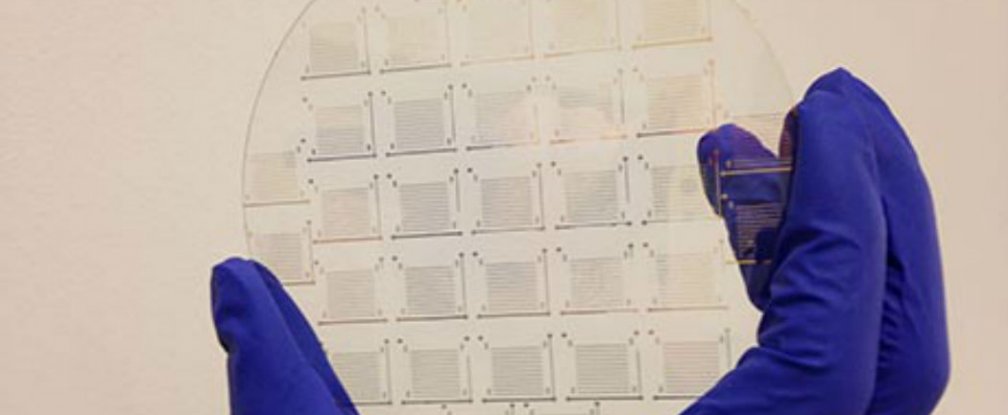
The team crystallised it down, and figured out how to peel ultra-thin sheets just a few atoms thick from the surface of the crystals. Amazingly, even at this thickness, the molybdenum disulfide film retained its electrical properties, which makes it a promising candidate for use in future electronics. "The electrical performance of our materials was comparable to that of reported results from single crystals of molybdenum disulfide, but instead of a tiny crystal, here we have a 4-inch (10-cm) wafer," one of the team, Jiwoong Park, said in a press release.
To create this atoms-thick molybdenum disulfide film, the team used a technique called metal organic chemical vapour deposition (MOCVD), which involves starting with a powdered form of the material, converting that into a gas, and sprinkling single atoms onto a substrate, one layer at a time.
"The process starts with two commercially available precursor compounds - diethylsulfide and a metal hexacarbonyl compound - mixed on a silicon wafer and baked at 550 degrees Celsius for 26 hours in the presence of hydrogen gas," explains Russell Brandom at The Verge. "The result was an array of 200 ultra-thin transistors with good electron mobility and only a few defects. Just two of them failed to conduct, leaving researchers with a 99 percent success rate."
Publishing in Nature, the team says the next step is to figure out how to produce the film in a more consistent way, so the conductivity can be more accurately measured. But what they’ve achieved so far is a real step in the right direction.
"Lots of people are trying to grow single layers on this large scale, myself among them," materials scientist Georg Duesberg from Trinity College Dublin in Ireland, who was not involved in the research, told Elizabeth Gibney at Nature. "But it looks like these guys have really done it."

Saturday, May 2, 2015

New project plans to plant one billion trees a year using drone technology

New project plans to plant one billion trees a year using drone technology
Time for some industrial scale REforestation.
 
US-based organisation, BioCarbon Engineering, has announced that it will begin planting one billion trees per year using drone technology, in an effort to combat the massive levels of deforestation that have affected many of the world’s jungles, bushlands, and forests.
Led by ex-NASA engineer, Lauren Fletcher, the team looked at the issue of how rapidly trees are being felled, and reasoned that on their own, people aren’t able to combat the problem. So why not use technology to combat technology? "We are going to counter industrial scale deforestation using industrial scale reforestation," they say on their website. "Destruction of global forests from lumber, mining, agriculture, and urban expansion destroys 26 billion trees each year. We believe that this industrial scale deforestation is best combated using the latest automation technologies."
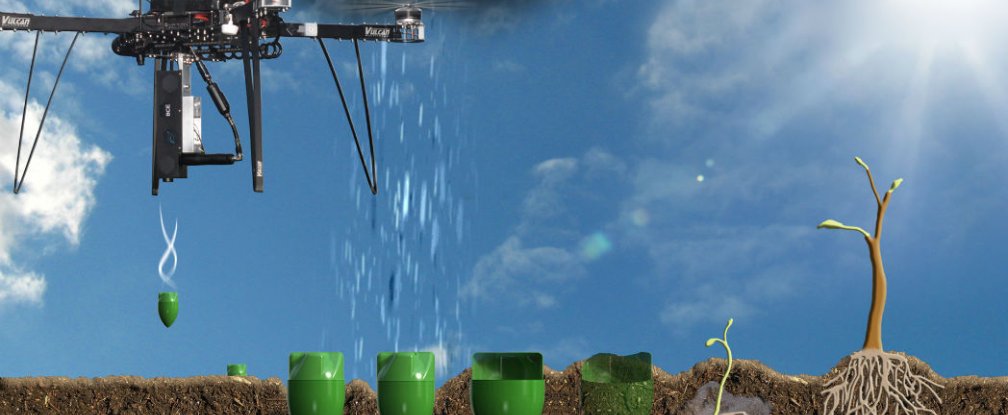
Right now, the rate of reforestation is about half that of deforestation, which is obviously entirely sustainable. Earth will literally run out of trees if we don’t come up with a better solution to speed up the process, which is severely held up by hand-planting. What the BioCarbon Engineering team plans to do is fly drones over specially selected planting areas and fire biodegradable plastic pods filled with pre-germinated seeds and highly nutritious soil down into the ground.
Once planted safely, the seeds will be watered and monitored by the drones, which will report back to the team about their health and growth patterns year-round. As Christopher Hootan says at The Independent, "Fletcher doesn't pretend that the method is as good as hand-sowing, but it's a hell of a lot quicker."
Hootan reports that the plan is to plant up to 36,000 trees a day, and at around 15 percent of the cost of traditional reforestation methods.
"The only way we're going to take on these age-old problems is with techniques that weren't available to us before," Fletcher told him. "By using this approach we can meet the scale of the problem out there."
Can’t wait to see this project get underway.

IBM scientists clear major hurdle for practical quantum computers

IBM scientists clear major hurdle for practical quantum computers
They've detected two main errors at the same time.
 
Quantum computers have the potential to rapidly sift through huge data stores to solve certain complex problems way faster than their classical counterparts. But before they can be of any practical use, researchers need to be able to detect and fix errors that can occur while transferring data.
Now, a team of researchers at IBM has built a quantum system that's capable of detecting and measuring the two main errors these machines are likely to encounter, overcoming a significant hurdle on the way to developing scalable quantum computers.
“With our recent four-qubit network, we built a system that allows us to detect both types of quantum errors,” physicist Jerry Chow, who manages IBM’s experimental quantum computing centre in the US, told Jeremy Hsu at IEEE Spectrum.
“This is the first demonstration of a system that has the ability to detect both bit-flip errors and phase errors.”
Classical computers understand information as bits, which carry a value of either 1 or 0. But in quantum computers, the main data components are single atoms known as qubits.
They represent the 0 and 1 of binary code, but by leveraging a strange phenomenon known as quantum superposition, they can exist in both states simultaneously. This gives rise to the potential of quantum computers to make certain calculations exponentially faster than classical computers, but it also gives rise to a broader spectrum of technical difficulties.
Classical computers are only subject to bit-flip errors - when bits change values due to noise or interference. These can be corrected relatively easily by copying the same bit repeatedly, and then taking the correct value from the majority, writes Hsu.
Quantum computers can experience these errors, but are also vulnerable to another problem known as a 'phase error', which flips the sign of the phase relationship between 0 and 1 in a superposition state. Detecting and correcting these errors in quantum systems is extremely challenging because the information, which essentially lives on the spin of an atomic particle, is fragile and short-lived, and can be disrupted when it interacts with any type of matter or radiation.
Until now, it was only possible to address one type of quantum error or the other at a given time, but never both. And for quantum computers to work this is imperative.
The IBM researchers were able to detect and measure both errors by relying on the phenomenon known as entanglement, by which qubits can nearly instantaneously share information with other qubits.
IBM’s device, which is described in the latest edition of Nature Communications, involved a square architecture of four qubits. Two of these represented data qubits, while the other two served a measurement function. Each of the measurement qubits was able identify bit and phase errors occurring between the data qubits, respectively.
The next step is to develop a scaled up system with more qubits that can not only identify errors, but solve them.
Earlier this year, another research team funded by Google reported in Nature the development of a linear array of qubits that was able to identify and correct errors. But importantly, as Hsu points out for IEEE Spectrum, this system could not detect and correct both errors at the same time.
The IBM team, which has been using standard silicon fabrication techniques, believes it will be easier to scale up their device. In the company press release, IBM says it “anticipates that once a handful of superconducting qubits can be manufactured reliably and repeatedly, and controlled with low error rates, there will be no fundamental obstacle to demonstrating error correction in larger lattices of qubits.”
While they're likely some way off, and aren't going to make your laptop any faster, quantum computers - once realised - will have a profound impact on a number of research areas. Right now, it's believed they'll be useful in the design of new super materials and drugs, but in the future, it's possible that all kinds of new applications we haven't yet pondered could open up.

NASA has trialled an engine that would take us to Mars in 10 weeks

NASA has trialled an engine that would take us to Mars in 10 weeks
And may have inadvertently created a warp drive in the process.


NASA scientists have reported that they've successfully tested an engine called the electromagnetic propulsion drive, or the EM Drive, in a vacuum that replicates space. The EM Drive experimental system could take humans to Mars in just 70 days without the need for rocket fuel, and it's no exaggeration to say that this could change everything.
But before we get too excited (who are we kidding, we're already freaking out), it's important to note that these results haven't been replicated or verified by peer review, so there's a chance there's been some kind of error. But so far, despite a thorough attempt to poke holes in the results, the engine seems to hold up.
The engine is controversial because it seems to violate one of the fundamental concepts of physics - the conservation of momentum, which states that for something to be propelled forward, it needs some kind of propellant to be pushed out in the opposite direction. But the EM Drive doesn't require any propellant in order to create thrust, it simply relies on electromagnetic waves.
However, British scientist Roger Shawyer, who invented the EM Drive in the early 2000s, disagrees that his design violates the conservation of motion. "To put it simply, electricity converts into microwaves within the cavity that push against the inside of the device, causing the thruster to accelerate in the opposite direction," writes Mary-Ann Russon over at The International Business Times, who interviewed Shawyer after the story on NASASpaceflight went viral.
Engineers over at NASA's Eaglework Laboratories have been trying to work out whether or not the results are real for months, and they've now ruled out their main hypothesis for why there would be an error by showing that the engine works in a vacuum. "Despite considerable effort within the NASASpaceflight.com forum to dismiss the reported thrust as an artefact, the EM Drive results have yet to be falsified," write José Rodal, Jeremiah Mullikin and Noel Munson for NASASpaceflight, one of the leading space flight news sites.

So what does all this mean? If the results can be replicated and verified in a vacuum (something that Eaglework engineers plan to do in the coming months), it would change the way we travel in space, and open up access not only to planets in our own Solar System, but in the systems beyond.

For starters, our payloads would become a whole lot lighter without the need for rocket fuel. It would also speed things up incredibly.
Harold (Sonny) White, the leader of the research group at Eaglework, predicts that a crewed mission to Mars inside a 2 MegaWatt nuclear electric propulsion spacecraft, powered by an EM Drive with a thrust/power input of 0.4 Newton/kW, could get to Mars in a mind-boggling 70 days.
Even more impressively, the NASA researchers predict that a trip to Alpha Centauri, the closest star system to our Solar System, would take just 92 years.
But Shawyer has some applications closer to home in mind - primarily, he hopes that the engine could be used to send cheap solar-harvesting satellites into space, with the ability to beam the power back to Earth.
"We will go to Mars, but the most important thing is what EM Drive will do for the rest of the world. It will be solar power stations, city-to-city long-haul flights using hydrogen. It's green and convenient and will change our world in the next few decades," he told Russon.
2015-04-29-174344Mark Rademaker
So where does warp drive come into all of this? The NASA engineers also reported on the forums that they'd fired lasers into the EM Drive's resonance chamber and that some of the laser beams had travelled faster than the speed of light, at around 300,000 kilometres per second... suggesting that the EM Drive may have produced a warp bubble like the kind that allows travel faster than the speed of light in Star Trek.
In reality, a spacecraft travelling at warp speed doesn't actually move faster than the speed of light, but it creates a bubble that warps spacetime around it so it has less distance to travel. NASA has already created designs of what this kind of ship might look like (spoiler: awesome). The presence of this kind of warp bubble is something that the engineers at Eaglework are going to investigate with an interferometer.
Of course, all of this requires a lot of gaps to be filled before we can even verify that results like these are possible. But it seems that we're now in a position where the engine warrants further investigation.
"After consistent reports of thrust measurements from EM Drive experiments in the US, UK, and China - at thrust levels several thousand times in excess of a photon rocket, and now under hard vacuum conditions - the question of where the thrust is coming from deserves serious inquiry," the NASASpaceflight authors conclude.
We couldn't agree more.