Saturday, April 25, 2015

This alarm wakes you with warm beams of light, and lets your partner sleep in


Save your mornings and your relationship.
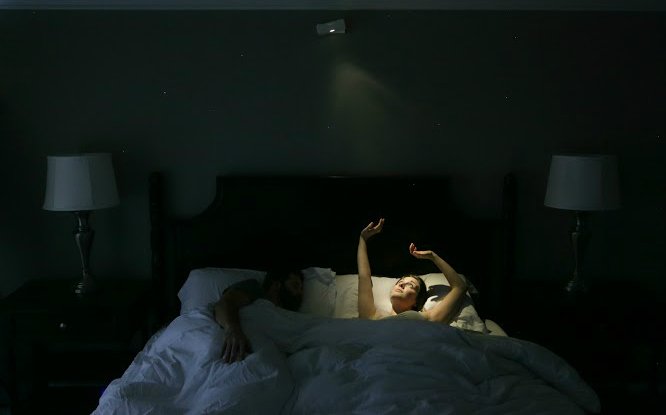
 
Having the annoying ring of an alarm clock slap you out of your warm, peaceful sleep is a painful truth that nearly the entire world has to live with, over and over again, every single morning of our arduous human existence. But engineers in the US may have just developed a device that could revolutionise the way we wake up using sunrise-like light and focussed sounds... and we're ready to stop them right there and hand over our money.
Rousing people with light is nothing new, Phillips started doing it back in 2006, and other variations on light-based alarm clocks quickly followed. But this new wall-mounted alarm, called Wakē, does something very different - it tracks your body using heat sensors, and then sends targeted beams of warm, white LED light onto your face, to replicate the feeling of a sunrise. Once your body has started to rouse naturally, the alarm then sends a wave of extremely focussed sound at you, allowing you to wake up fully without your partner hearing a thing.
So how does it work? The device was created by mechanical and electrical engineers from Lucera Labs, and uses an infrared sensor to find out exactly where your body is on the bed. All you have to do the night before is tell it which side of the bed you sleep on using the connected smartphone app, and what time you want to wake up. It's then able to focus gradually intensifying light and sound directly at you (and only you) using targeted white LED lights, and parametric speakers.
ParametricSpeaker
These speakers use interacting ultrasonic waves, which are much shorter than regular sound waves, to create a "laser beam" of sound that's only audible to the ears of someone directly in its path. You can see it in action below around the 2:10 mark:
The infrared sensor is so precise that if you start to wake up, hit snooze and then roll over to spoon your significant other, the Wakē will follow you and 10 minutes later start the wake up process again, targeted right at your new position.
Importantly, the wifi-connected alarm clock doesn't contain cameras or any recording devices that could be hijacked online and used against you, as the creators are very quick to point out. And the device only needs to be charged a few times a year.

You can find out more about the engineering behind the scenes in the video below, which was released as part of the lab's Kickstarter campaign to fund the alarm clock. The first round of prototypes, which are scheduled to be shipped in September this year, are already sold out.
On behalf of all of us who have partners who work late nights (fellow hospitality widows, I'm talking to you) or ridiculously early mornings, I'd like to say a very heartfelt thank you to science. Now shut up and take my money.

Tuesday, April 21, 2015

Qualcomm may get Samsung’s help making the Snapdragon 820

Samsung’s helps making the Snapdragon 820
 
The Snapdragon 810 may be the system-on-a-chip powering the hot new smartphones of the moment – devices like the just-launched Sony Xperia Z4 – but the next big thing is already around the corner, and early last month Qualcomm announced the Snapdragon 820. The big news for that chip sounded like it would be Qualcomm’s move away from off-the-shelf Cortex A-series cores and to Qualcomm’s custom Kyro microarchitecture, but we didn’t have a ton of technical details at the time. As more information comes to light, there’s a new report out that Qualcomm could be turning to a sometimes-competitor for help bringing the 820 to market, enlisting Samsung to fabricate the SoC.
While Qualcomm has had TSMC fabricate much of its silicon in the past, for the 820 the company reportedly wants to use a 14nm process, while TSMC is still set up for 20nm. Samsung, on the other hand, has already made the transition to 14nm, as we saw with the Exynos 7 Octa 7420 in the new Galaxy S6. That makes it an obvious candidate for Qualcomm to turn to as it gets ready to start providing 820 samples to manufacturers.
Between this, Samsung’s own Exynos SoC efforts, and word that Samsung might produce the A9 chip powering the next generation of iOS devices, Samsung’s fabrication business could end up having one hell of year.

52-megapixel cameras on smartphones


52-megapixel camera


The project is in progress and will see light of day as early as next year (Representational image)
A startup firm in Silicon Valley, named as Light, is working hard to revolutionize the photography industry related to smartphone cameras. The project is in progress and will see light of day as early as next year.
MIT Technology Review got an insider about the company and the technology they are working on. The technology of producing higher megapixels is interesting and they way they are planning to achieve is mind blowing.
Light is using a technique, which involves using a cluster of small camera modules together to create high-resolution photographs. They have decided to use the technology on the most used personal gadget that everyone caries around everyday—the smartphone.

Most digital cameras feature a sensor and a lens. When light hits the sensor, an electric current is flown through the sensor to produce a digital photograph. When using multiple cameras, each sensor paired with its own lens, and fired at the same time, they can take a higher resolution photograph. But it is not as easy as you think. The photographs from each camera sensor have to go through intelligent software, which combines the multiple images into one, single high-resolution photograph. Using this technique, Light believes that they can now embed the equivalent quality and zoom of bulky, expensive DLSR cameras into smaller and cheaper packages, such as smartphones and compact cameras.
Presently, the company is still developing the technology and does not have a fully working prototype as yet. But Light is confident that they will have a breakthrough soon and expect it to be a reality on smartphones by early 2016.
Light is planning on a deal with Foxconn, the world’s largest electronics manufacturer. Foxconn will license the technology from Light for its future smartphones. Last year, Light had raised around $9.7 million from various investors.
According to MIT, Light is taking advantage of the decreasing costs of the optics and also the declining weight and size.
MIT got a preview of the present prototype at their California office. (Photo credit: MIT). The device, as big as a car’s rearview mirror, was cramped with 16 camera modules, ranging in focal lengths, such as 34, 70 and 150mm. The idea to incorporate several cameras with different focal lengths is so that you can capture the same image from multiple angles and perspectives. This in a way also replicates how the zoom works on a DSLR camera. The combined images result in a photograph that emulates a bigger camera lens. Light did not give a working demo of the camera as yet, but they did show an image captured by four 8MP cameras and combined with the software.
The new technology will be a boon to shutterbugs that are looking for lighter equipment when travelling. When implemented in smartphones, it can convert the smartphone into a next-gen AIO gadget on the go. Light is definitely on the road to building the future of cameras.

BMW's 7 Series lets you park by remote control


BMW's 7 Series

If you're looking at a BMW's deluxe 7 Series, the 2016 model will awe your yacht club pals with some Bond-worthy gadgets. The remote control parking appears to be a first for a production vehicle, even though we've seen it demo'd by Volvo, Audi and BMW before. When you use the touchscreen-equipped BMW Display Key, it'll squeeze itself into (and out of) a parking space in a fully automatic process. Self-parking is already available on BMW's i3 electric vehicle and many others, but the 7 Series is the first to let you park when you're not even in the driver's seat.
Another much talked about, but so far un-buyable feature is gesture control. BMW's 7 series will let you wave your hands around to accept or reject phone calls and control media volume, to name a couple of features. Along with a touchscreen, the system will take single finger, two finger and full hand movements, and BMW says you'll be able to create custom gestures for various functions. To top it off, the new vehicles will get driving assistant systems including steering and directional control assistance, lane departure warnings and cross traffic warnings.
The vehicle's body will use copious carbon fiber for 130 kg (280 pounds) less curb weight, and sport highly tunable drive dynamics thanks to an air suspension. There's no word on pricing yet, and tsk, tsk for even asking -- but the 2015 models start at $68,500 and run all the way up to $130,000.

Sony announces the Xperia Z4 with Snapdragon 810

Source: SONY Japan 
Update: we’ve asked the question at the end of the post, and it looks like it’s been answered. Apparently, the Xperia Z4 is only for Japan, but the rest of the world will get a different flagship by the end of May, according to this report.
Finally all the rumors can come to an end as Sony announces the Xperia Z4, one of the most rumored (and leaked) smartphones of the year. It will replace (or at least it will try) the predecessor, the Xperia Z3, which was already an incremental upgrade to the Xperia Z2. If you were expecting a design overhaul, you’ll probably be disappointed, as Sony has decided to go with the same design and build (glass and aluminum sandwich).
However, on the inside, the specs have been bumped to make the already fast Xperia Z3 even faster with the Z4. A Qualcomm Snapdragon 810 processor sits at its core, helped by 3GB of RAM and 32GB of internal storage (expandable via microSD card). The screen is (still) a 5.2-inch unit with Full HD resolution, and the camera on the back is still one of 20.7 megapixels, with a 1/2.3-inch Exmor RS sensor behind the lenses and Sony’s own BIONZ image processor. The camera on the front has been dramatically bumped to 5.1 megapixels, while the battery takes a slight hit, the Xperia Z4 packing a 2,930mAh battery.
Weighing 144gr. and measuring 6.9mm in thickness, the Xperia Z4 is slimmer and lighter than its predecessor, but it is just as dust and water resistant with its IPX5/IPX8 ratings.
There is no word and details about exact pricing at this point, but Japan should see the Xperia Z4 sometime this summer. Whether this will be a Japanese-only unit (judging by its current appearance only on the Japanese website) or it will go global is yet unknown.
Xperia Z4 colors front Xperia Z4 colors

Monday, April 20, 2015

Palm Piston

According to its name, the pistol fits comfortably into the shooters hand. It is supposed to be used for home and self-defense or as a backup weapon and it shoots by pushing with the thumb rather than pulling a conventional trigger. The small pressure required to fire reduces the unintentional moving of the muzzle downward from the desired direction of shooting. With dual independently operable grip safeties, chances of accidental discharge are negligible and its ergonomic design is suited for both left and right handed users. The pistol features a loaded chamber indicator and cocked striker indicator so the user knows if the weapon is ready for use.


Subtracting the optional picatinny rail (a standard firearm mounting platform), which is there to support the LaserLyte V2 laser site, the .38 special caliber gun weighs only 13.4 ounces (almost 380gr).


The Palm Pistol has special cartridge called Tri-Plex™ .38, which features three stacked conical projectiles that separate and tumble upon firing. This greatly increases the chances that an aggressor will be prevented from inflicting harm on their victim.


 In a full of adrenaline self-defense situation, people without experience in shooting may be prone to a bad mistake. They may fail to properly draw, ready and aim their weapon, or may simply miss. Due for release this year, the Palm Pistol is designed to give non-aggressors a better chance of surviving a violent attack.